
Membership, Contributions, or Patrons: How Money Reaches Your Community
YeahApp has three separate ways money arrives from the people around your community: recurring dues that buy access, recurring giving that buys nothing, and one-off donations toward a single event. How to tell which one you're actually looking at, with a close look at churches and mosques.
A club treasurer sits down in October with three payments to sort out. One is annual dues from a player. One is a standing order from a parent who hasn't kicked a ball in twenty years but wants the under-11s in proper kit. One is €500 from the garage on the high street, for the end-of-season tournament, and they'd like their logo on the poster.
Three payments, three genuinely different things. YeahApp has a separate rail for each of them, and reaching for the wrong one is the most common setup mistake we see.
Three questions, in order
Work through these and the answer falls out.
Is it recurring, or one-off? Money that arrives every month until somebody cancels is a membership plan or a contribution. Money that arrives once is Patrons.
Is it for the community, or for one event? Membership plans and contributions attach to the whole community and run until cancelled. Every patron donation is tied to a single event. You can't donate to a community in general through Patrons.
Does it buy access? This is the only question separating a membership plan from a contribution. A membership plan can lock your community so that only paying members get in. A contribution never locks anything, and neither does a patron donation.
Notice what isn't on that list: whether the person is a member. The public support page doesn't ask anyone to log in, so one of your own members can give through it as easily as a stranger can. The real split is recurring against one-off, not insider against outsider.
Three rails, one club
Back to the treasurer, because all three of those payments belong in the system at once and they don't collide.
The player's dues are a membership plan. €120 a year, gating the training schedule and the fixture list. Miss a payment and access closes. That's the whole point of it: the money buys something specific, and the club needs a clean line between who has paid and who hasn't.
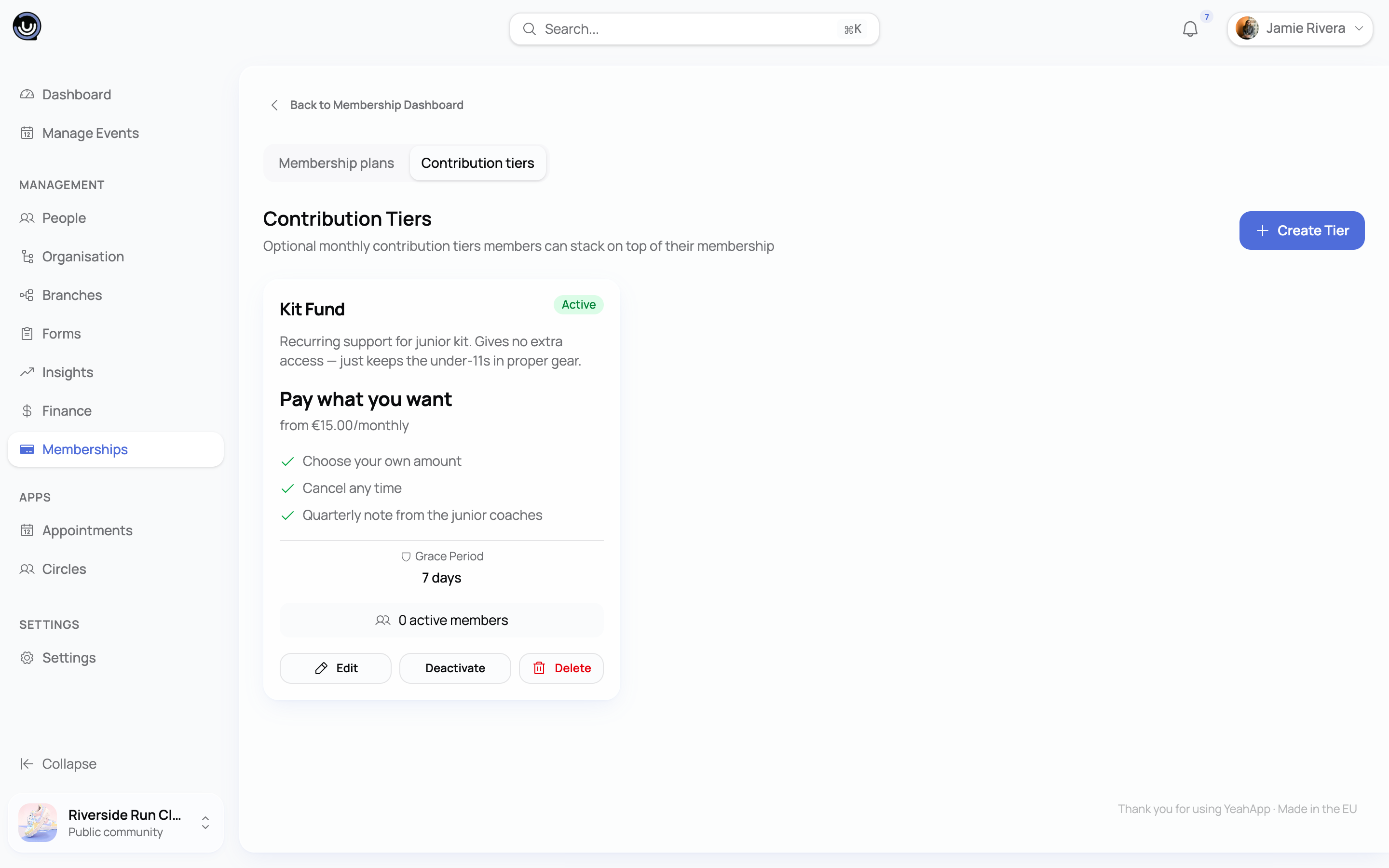
The parent's standing order is an open contribution. €15 a month toward kit. It gates nothing, because there's nothing to gate. That parent already has all the access they want. They're funding the club rather than buying from it.
The garage's €500 is a patron donation. One payment, tied to the tournament, with a logo on the event page and an invoice for the garage's own books. Nobody at the garage has an account, a membership, or any intention of getting either. They paid for a thing happening in June.
One club, three rails, no conflict between them. A single person can even sit on two: someone can hold a membership and a contribution at the same time, and both run side by side.
| Organisation | Membership | Contribution | Patrons |
|---|---|---|---|
| Sports club | ✓ dues gate training | ✓ supporters fund kit | ✓ tournament sponsor |
| Church | ✗ never a gate | ✓ tithes and offerings | ✓ Christmas concert, outreach dinner |
| Mosque | ✗ never gate the prayer hall | ✓ ongoing sadaqah | ✓ business funds the iftar |
| Professional association | ✓ annual dues, gated directory | ✗ dues are the model | ✓ conference sponsor |
| Nonprofit | ✗ access is the mission | ✓ recurring donors | ✓ funder backs one programme |
| Learning community | ✓ membership required | ✗ would cannibalise dues | ✗ no external funders |
Churches and mosques, in detail
Congregations are where all three rails show up together, and where the edges of the system are easiest to find. Churches and mosques land in almost the same place for the same reason: the thing at the centre was never for sale.
Start with what not to do. Sunday service is not a membership plan, and neither is Friday prayer. Modelling congregational membership as a paid plan is an understandable instinct and it's the wrong one, because a membership plan's only job is to lock a door. If nobody is ever turned away, there is no door, and the plan does nothing except add a bill. A formal membership roll works better as ordinary community membership at no charge, with a member group marking who's on it if you need that distinction visible.
Giving is a contribution, and it should be flexible
In both, the giver sets the amount rather than the institution. Tithes and offerings scale with income. Sadaqah is whatever someone decides to give, whenever they decide to give it. That is the one thing a fixed price cannot handle, because no single number fits a congregation.
Set a contribution tier to flexible and your figure stops being a price and becomes a suggestion. Each person enters their own amount at or above your floor, and that amount is what recurs. You cannot do this on a membership plan: a price that controls access has to be fixed, or the gate means nothing.
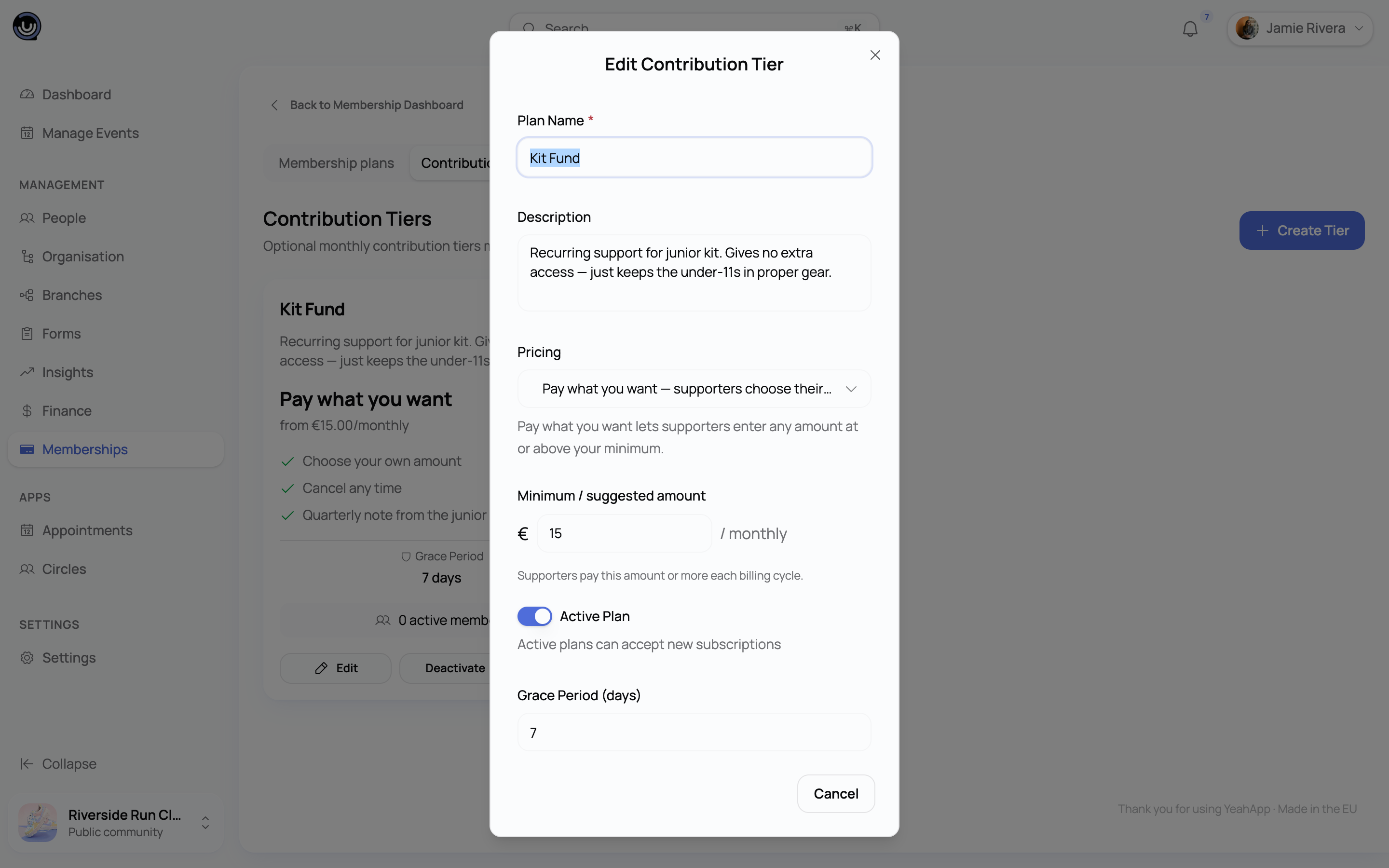
A monthly flexible tier covers regular giving on either side, whether that's a standing offering or ongoing sadaqah. You can run more than one tier if it helps to name them separately, a general fund and a building fund say, but know the constraint before you advertise it: a person holds one contribution at a time. Nobody can give to two tiers at once, so they pick the one that matches how they already give.
Paid programmes sit outside all of it. The marriage course, the youth camp, the weekend madrasah and the Arabic class are events with tickets. Home groups, midweek study and halaqas are Circles. Neither needs a membership plan, and reaching for one usually means somebody has confused "we charge for this activity" with "we charge for belonging here".
Two limits worth knowing before you set up
There is no weekly billing cycle. Plans run monthly, quarterly, semi-annually, annually, or as a single lifetime payment. A church thinking in weekly envelopes and a mosque collecting at Friday prayer both want something that isn't there. The practical answer is to set the monthly amount at roughly four times the weekly figure and explain the change from the front. It's a real gap rather than a workaround we're dressing up as a feature.
Contributions also have no progress bar. If you're raising for a building fund or a prayer hall extension and you want people watching €40,000 of €100,000 climb on a public page, that's a Patrons campaign, and Patrons campaigns attach to events. So the fundraising dinner or the Ramadan appeal night can carry a goal and a progress bar. The fund in the abstract can't. Some congregations solve this by making the campaign an event in its own right, which works fine, but it's better to know before you promise anyone a thermometer.
More than one site
Run several sites as branches of one community, whether that's a multi-campus church or a network of masjids under one organisation, and every branch uses the parent's connected Stripe account and its currency. Giving from all of them lands in the same place. For central finance that's exactly right. Where each site keeps its own books and answers to its own treasurer or trustees it isn't, and there's no setting that changes it: those sites need to be separate communities instead. Sub-communities and branches covers that trade in full.
Where Patrons starts
Patrons is a separate app you install, at €49.99 a year, and it does one thing. It lets someone with no YeahApp account give money toward a specific event.
They get a public support page with suggested amounts and a goal, an optional logo on the event page once you've approved it, and a proper Stripe invoice with a hosted page and a PDF. You get a record of every patron and everything they've given across every event, which is the part that matters when you go back to the same sponsors next year.
The fee is a flat 1%. That's lower than the rate on membership and contribution money, which follows your plan: 6% on Starter, 3% on Pro, 1.5% on Business. On Pro, that 2% difference means the app covers its own cost somewhere around €2,500 of donations a year.
None of which means you should route everything through it. You can't. Patrons is one-off only and event-scoped only, so it can't hold a monthly giver or fund the community in general. It's cheaper because it's narrower.
Two other kinds of money aren't part of this decision at all. Ticket sales are what someone pays to attend. Co-host sponsorship is one community paying another for an event they run together, and it arrives with co-hosting rather than with any of these three.
Which rails you actually need
Most organisations need one or two.
If you sell access, you need a membership plan and probably nothing else. A paid learning community that adds contributions on top usually finds they cannibalise the dues, because people who would have paid €30 a month give €5 instead once you hand them the option.
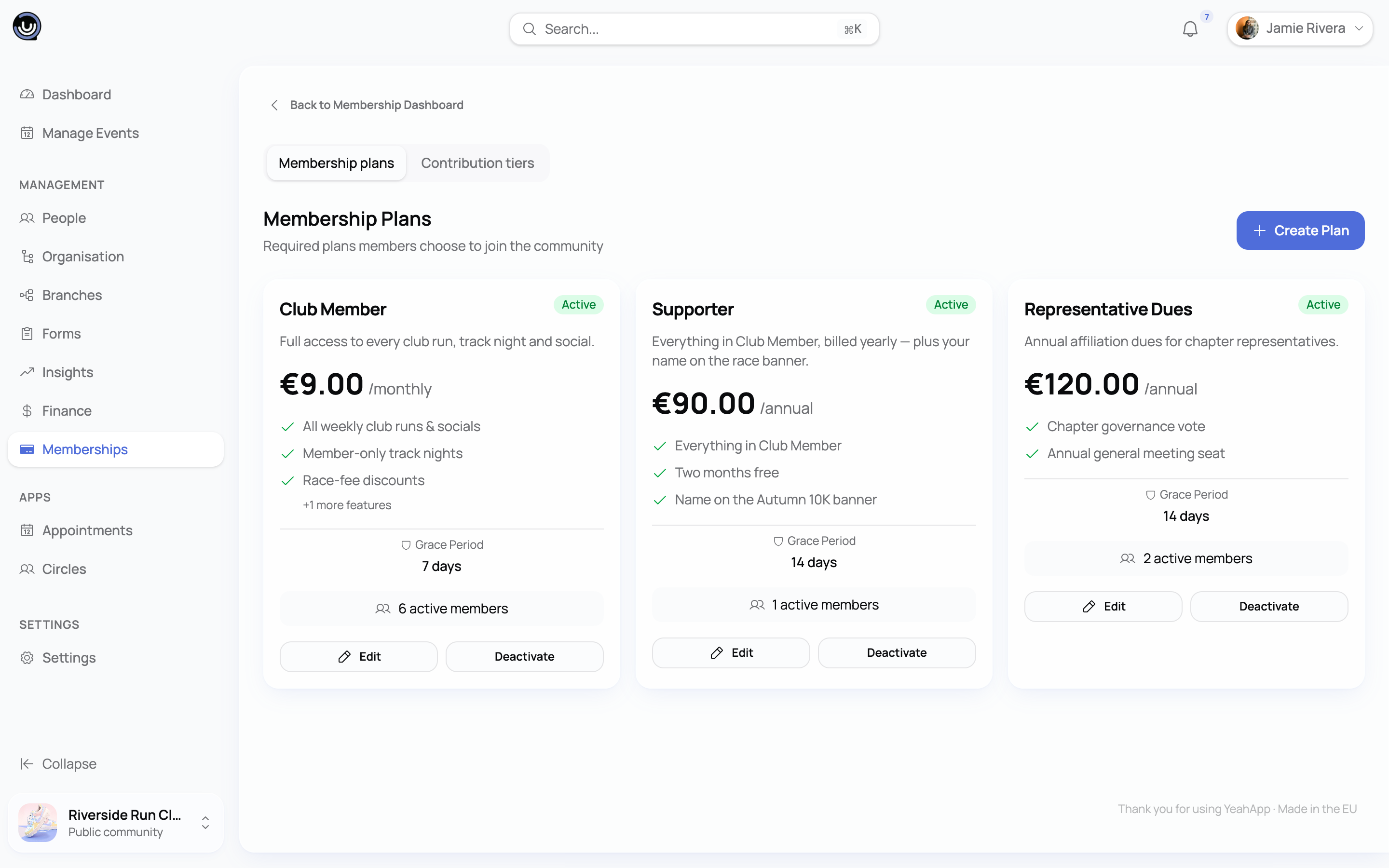
If you can't gate anything, you need contributions, plus Patrons when particular events attract outside money.
If you gate some things and take support for others, you may genuinely need all three. They coexist without stepping on each other. The club at the top of this article runs all three and stops thinking about it after setup.
Membership plans and contributions both need the Pro plan. Patrons installs on any plan. Creating a membership plan covers the setup for the first two, Extending your community with apps covers installing the third, and Understanding your community's money shows where all of it lands afterwards.
If you're not sure which shape fits your organisation, book a demo with us and we'll work through it with you.