
Circles: What a Run Club and a Halaqa Actually Need
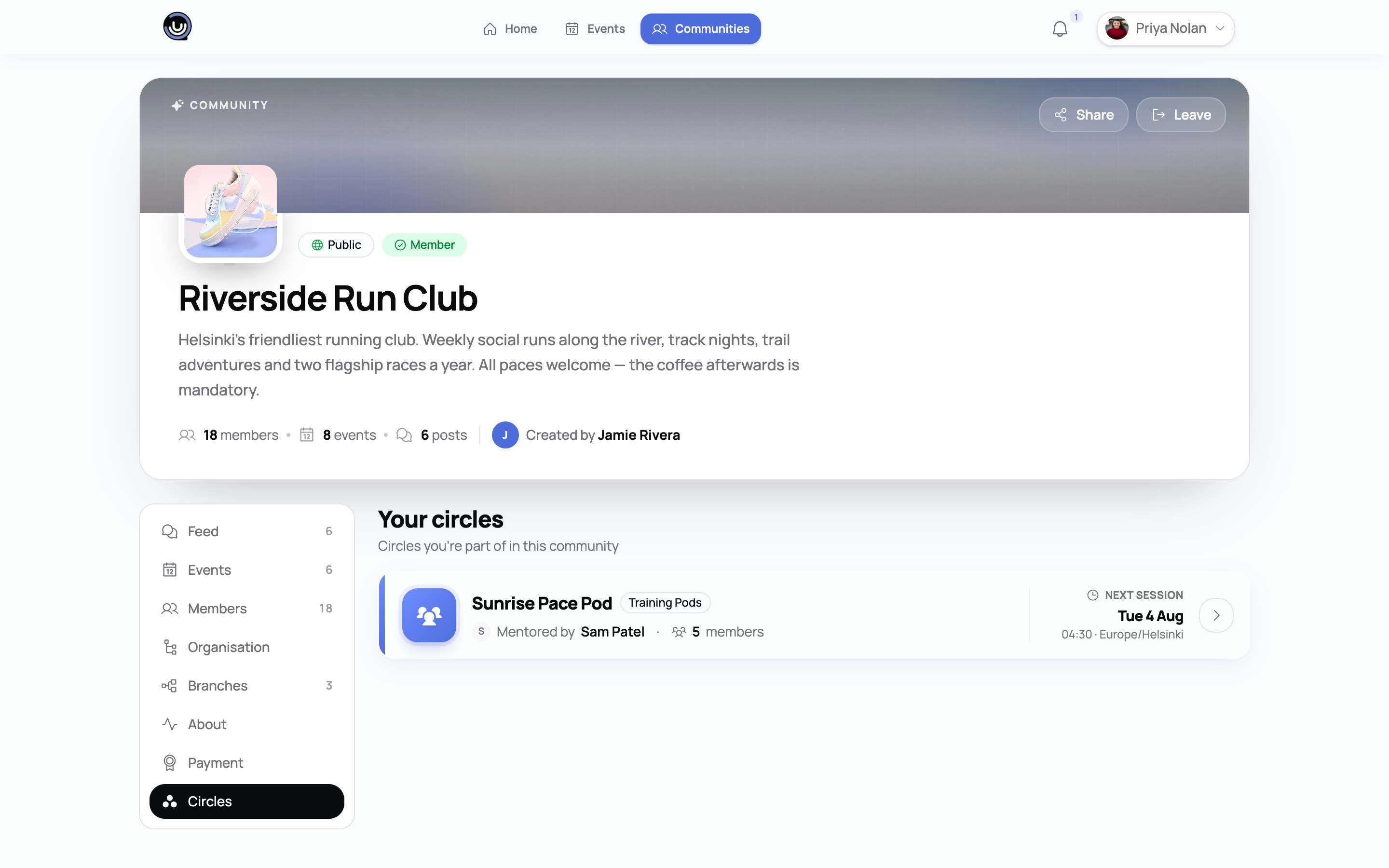
Circles runs any small recurring group: a weekly training session, a Thursday-night halaqa, whatever meets on a repeating schedule. It's run by a Mentor instead of an admin, sessions appear on their own, and attendance replaces RSVPs. Two very different organisations, the same feature underneath.
Two Thursday evenings look nothing alike. In one, a group of runners is midway through a set of 400-metre repeats, the same person calling out splits they've called out every week for a year. In the other, a group is sitting in a circle at a community centre, partway through a chapter they left off on last week, with the same person leading the discussion they always do. Neither group would recognise what the other is doing.
Strip away what they're actually doing, though, and they need the same three things: a fixed group of people, a time that repeats, and someone keeping a record of who actually turned up. YeahApp built a feature for exactly that shape and called it Circles.
What a circle actually is
A circle is a small recurring group inside your community, set up by an admin but run day to day by an ordinary member: the circle's Mentor. The Mentor sets one schedule, a day, a time, online or in person, and every session after that appears on its own, generated automatically on a rolling three-month window. Nobody creates sessions by hand and nobody RSVPs to them. Being in the circle is the only yes there is. Once a session happens, the Mentor, or an Assistant they've appointed to help, marks who attended and can note what the session covered.
A run club's Tuesday session
A running club rarely trains as one group. People run at different paces, so most clubs split into pace groups long before anyone needs software to manage that. Set each pace group up as its own circle, put them under one shared category so the admin list doesn't turn into a wall of unrelated entries, and hand each one to whoever already leads it. The person who's paced the sub-25-minute 5K group for the last year becomes that circle's Mentor. If they're away one week, an Assistant they've appointed, often whoever paces second most often, runs the session without anyone touching the admin panel.
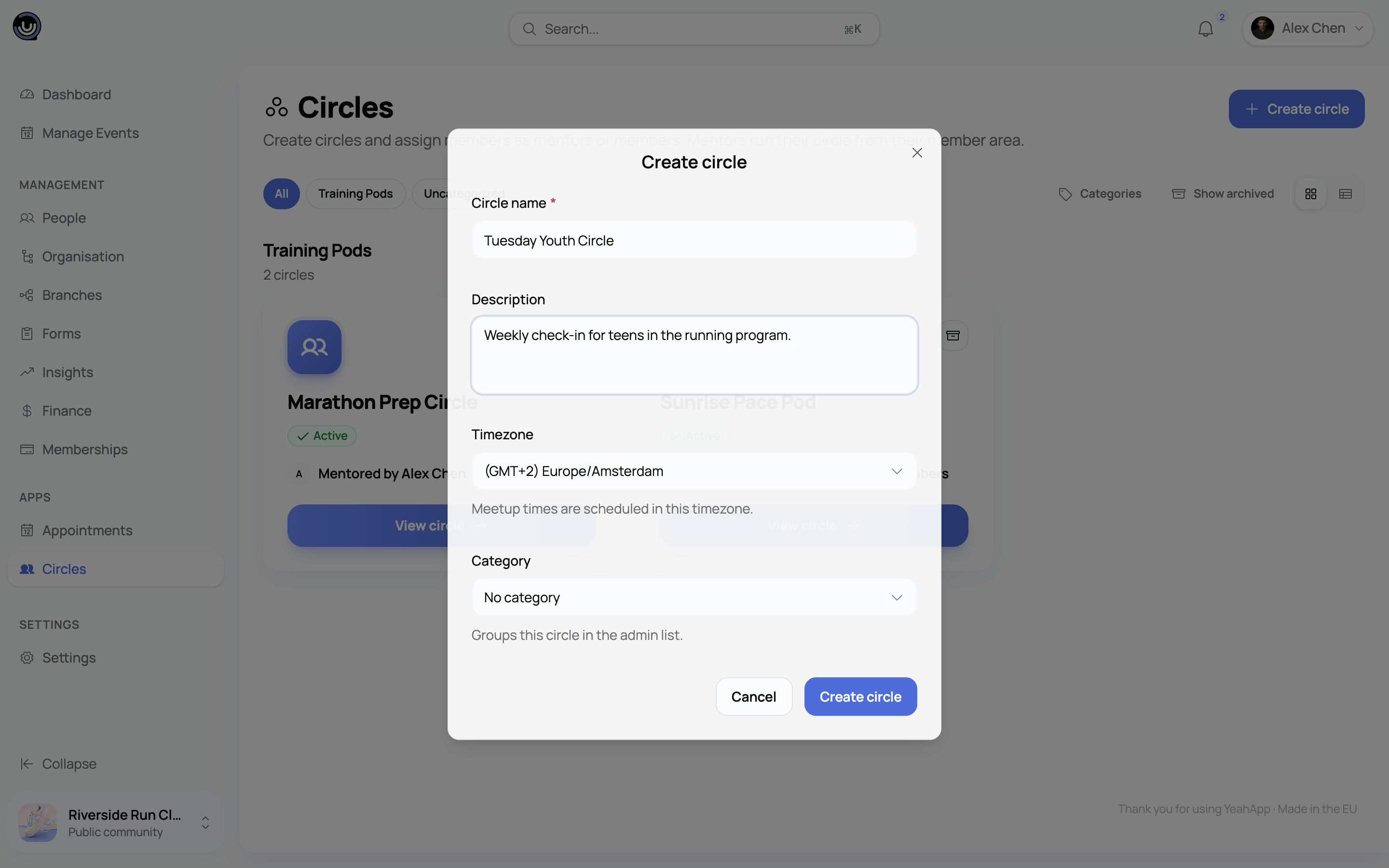
A circle's schedule is really just a day, a time, and a place, which is enough to carry an entire training plan implicitly: intervals at the track on Tuesday, a long run from the usual car park on Saturday. Discussion notes end up holding whatever the group needs written down afterward: the route, the distance, how conditions were, whether the session got cut short for weather. Someone who missed a week can read what happened instead of asking around for it.
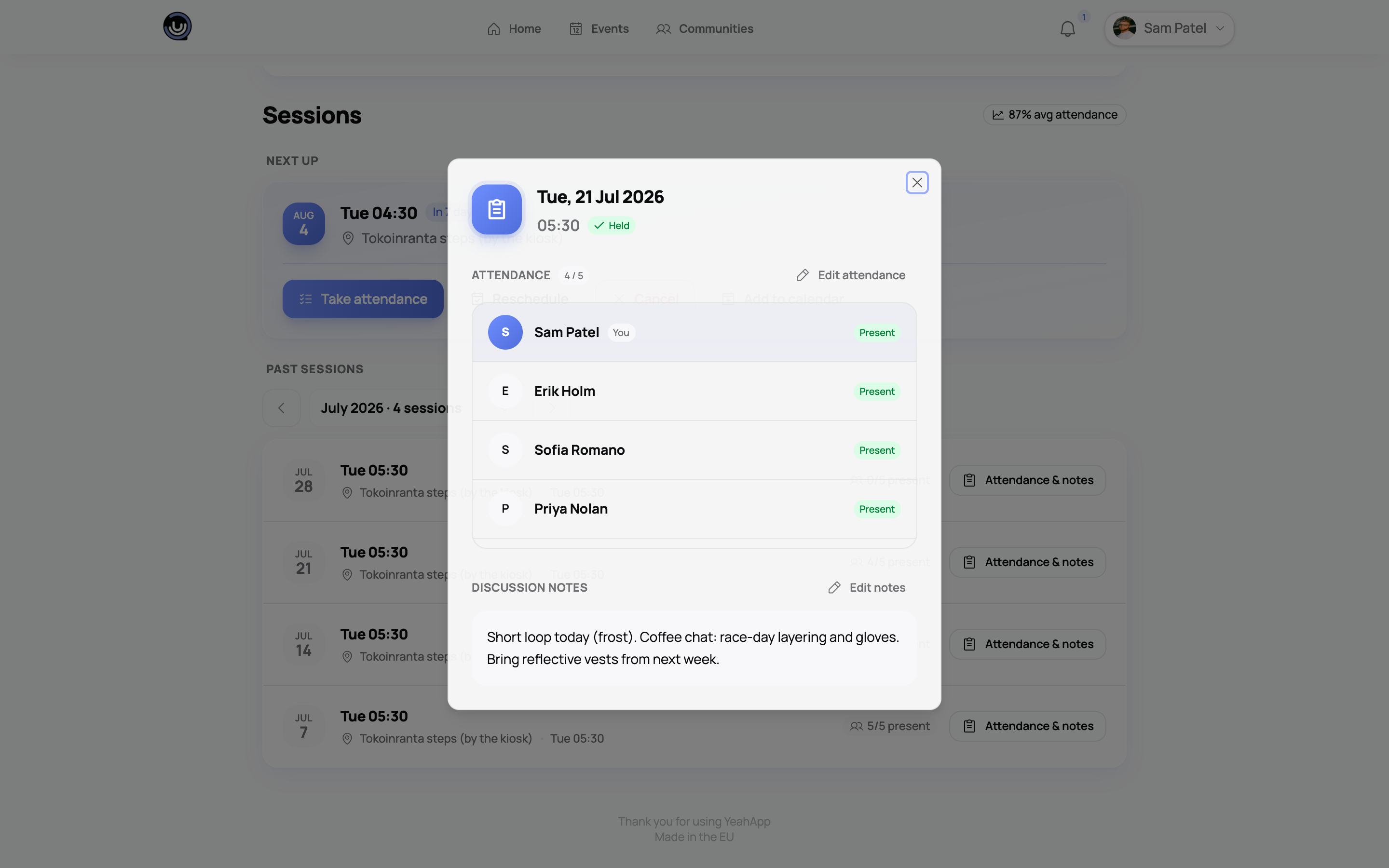
Attendance is doing two jobs here. It's a record for whoever's tracking training consistency ahead of a race, and on a trail or road session it doubles as a headcount: knowing who set out is the first thing anyone needs if a runner doesn't check back in. Neither job needs a membership system behind it, and showing up to run isn't something anyone had to confirm in advance.
Most clubs also charge dues, and that's where a pace group's Mentor gets something extra without any extra complexity. If the club has an active membership plan, the Mentor sees a Paid, Trial, Unpaid, or No membership badge next to each name in their group, and a Nudge button next to anyone who's unpaid or never taken a plan at all. What the Mentor doesn't see is which plan someone's on or what they're paying. That stays with whoever actually manages the club's billing. A pace-group lead can follow up with their own runners without being handed the club's finances to do it.
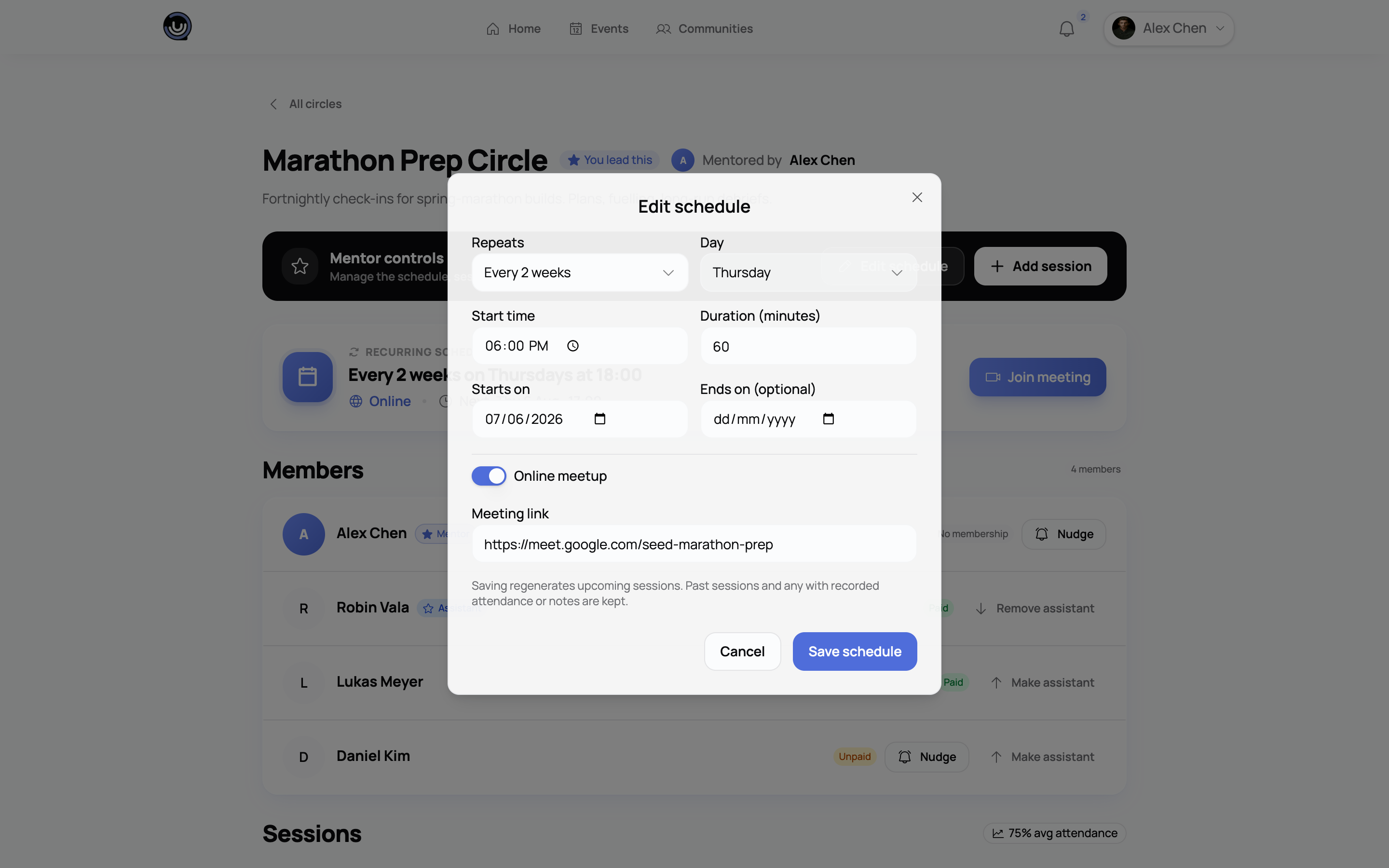
Every session can also be exported straight to a calendar app, so nobody needs a weekly "track session tonight" reminder post. It's just already there.
A halaqa on a Thursday night
A Muslim community organisation runs into the same shape from a completely different direction. A weekly halaqa, a study or discussion circle built around a text or a topic a volunteer teacher has prepared, has the same fixed group, the same repeating slot, and the same volunteer running it that a pace group does. Larger organisations often run more than one at a time: a men's halaqa, a women's halaqa, a youth halaqa, each on its own evening with its own teacher. Each becomes its own circle, and each teacher becomes that circle's Mentor without gaining any authority over the others.
Where a run club's discussion notes hold a route, a halaqa's hold whatever was actually studied: the surah, the hadith, the topic that week's session worked through. That matters the moment someone misses a week and wants to know what to catch up on, or when the organisation wants a real record of what a group has covered over a term instead of relying on someone's memory.
Attendance matters here for a reason that has nothing to do with money. An organisation that wants to know whether people are genuinely engaging, not just nominally signed up, gets that from the same present-or-not record a run club uses for a headcount. What it doesn't get, deliberately, is a reason to put a price on showing up. A membership plan can lock a community so only paying members get in. A circle never does that, on either side of this comparison. If the organisation doesn't charge anything at all, the halaqa's Mentor sees a plain list of names: no fee badges, no Nudge button, because there's no membership plan for that panel to reflect. If the same organisation separately runs a small annual membership for something else entirely, that Mentor view picks up the same coarse Paid or Unpaid badges the run club's leads see, still without exposing a single amount. The feature doesn't assume either answer. It reflects whichever one is actually true. Membership, Contributions, or Patrons goes into why gating the prayer hall or the study circle itself is the one thing worth avoiding on purpose.
Same feature, two rosters
| Run club | Halaqa | |
|---|---|---|
| What's a circle, here | One pace group | One study group |
| Mentor | Whoever already paces that group | The volunteer teacher for that group |
| Cadence | Weekly, sometimes twice as two separate circles | Weekly |
| Format | In person: track, road, or trail | In person or online |
| Discussion notes hold | Route, distance, conditions | Surah, topic, or hadith covered |
| Attendance is used for | Training consistency and a safety headcount | Engagement, without pricing it |
| Fee roster | Usually on, most clubs charge dues | Depends entirely on whether the organisation charges anything at all |
What a circle isn't
A circle isn't an RSVP list. Nobody confirms before a session, because there's nothing to confirm. It isn't a membership plan either. It never locks a door, even for an organisation that also runs one elsewhere. And it isn't ticketing: a one-off class or a paid weekend course is an event someone buys a ticket to, not a circle they belong to. Circles: recurring groups covers the full mechanics, schedules, sessions, notes, the member-facing side, in more depth than a use case needs.
Setting one up
Circles is a marketplace app, installed once per community from the same place every marketplace app comes from. Extending your community with apps covers that part. After it's installed, an admin creates the circle and decides who its Mentor is. Everything above follows from there on its own.
If you're weighing whether your organisation's recurring groups fit this shape, book a demo with us and we'll work through it against your actual groups.